
Coolant system woes in Modern BMW’s By Mporium BMW, LLC
Coolant systems in modern euro cars like BMW have increased in complexity over each generation in an ongoing effort to increase efficiency, performance, and reduce emissions. This ever increasing complexity has been a source of disdain for brand enthusiasts as owners are forced to perform costly repairs to their car’s coolant system as they age and deteriorate. We propose that these systems can be quite reliable and long-lived when ideal preventative maintenance is performed and the system is frequently inspected and minor leaks repaired as needed. Eventually, as the car and its components deteriorate due to age, a more significant overhaul should be prescribed to renew its integrity and extend its lifecycle.
Coolant system complexities?
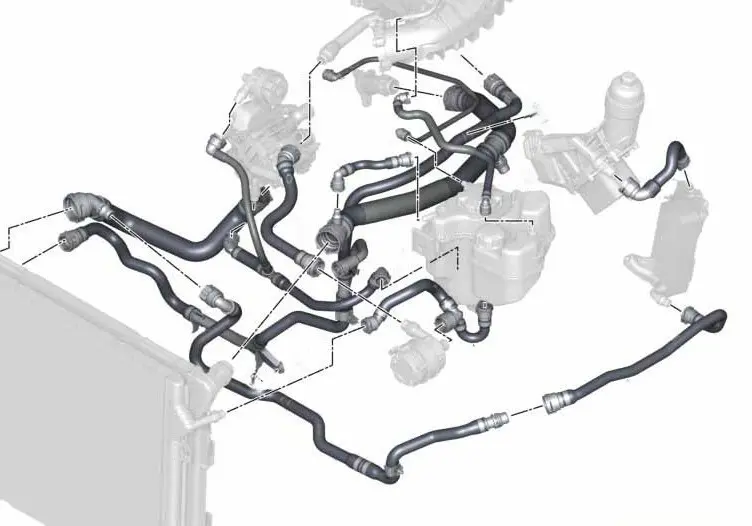
In past times, coolant systems were a marvel of simplicity with only a radiator, reservoir, and a few hoses needed to keep the engine operating at the correct temperatures. How times have changed. Current BMW models contain a maze of some of the most complex systems ever designed, with dozens of components and even more hoses to interconnect them all. Furthermore, we see multiple cooling systems for not only the engine, but for cooling the charge air, aka the turbocharger “intercooler”, or “low temp” circuits. Have a Hybrid BMW? Add yet another system to keep its motors and batteries cooled!
It may be fascinating to learn that all these components and their functions are very closely managed by software in the car’s computer system. Temperatures must be closely regulated by the car’s computer and to do so everything must work in harmony by receiving and transmitting sensor data through a vehicle-wide data bus system. Of course, the engine itself must never overheat, but regulation of temperature up and down also has an effect on efficiency and even emissions, therefore the systems have grown to have an exceedingly complex architecture to accomplish their tasks. We can look briefly at some of their more common failure prone components;

Radiator: Easily recognized by almost any owner, this device flows hot coolant and requires air flow over its fins to reduce coolant temperature.
Heat Exchanger: Similar to a radiator, but uses cooled coolant to transfer heat from a fluid or oil. Most models usually contain several of these for various systems.
Water Pump: The heart of the system circulates coolant throughout and may be electric or mechanical depending on the model.
Auxiliary water pump: Certain models may contain multiple additional pumps for various systems like turbocharger boost, air conditioner parts, or hybrid systems.
Thermostat: The temperature regulator. Also known as a “heat management module” in modern variations, its design can be quite complex. This assembly opens or closes coolant flow and more complex variations have valves that can divert or vary flow into various coolant paths as commanded by the control modules.
Expansion Tank: The reservoir of the system, it helps maintain a consistent coolant level without air pockets. This is where the driver adds coolant as needed. Some models may have two or more of these reservoirs, one for each system.
Hoses: Of course, hoses and pipes exist to ferry coolant between components. These may be soft rubber, steel, aluminum, or plastic. These are usually sealed with o-rings, which are a common source of leaks as they age.
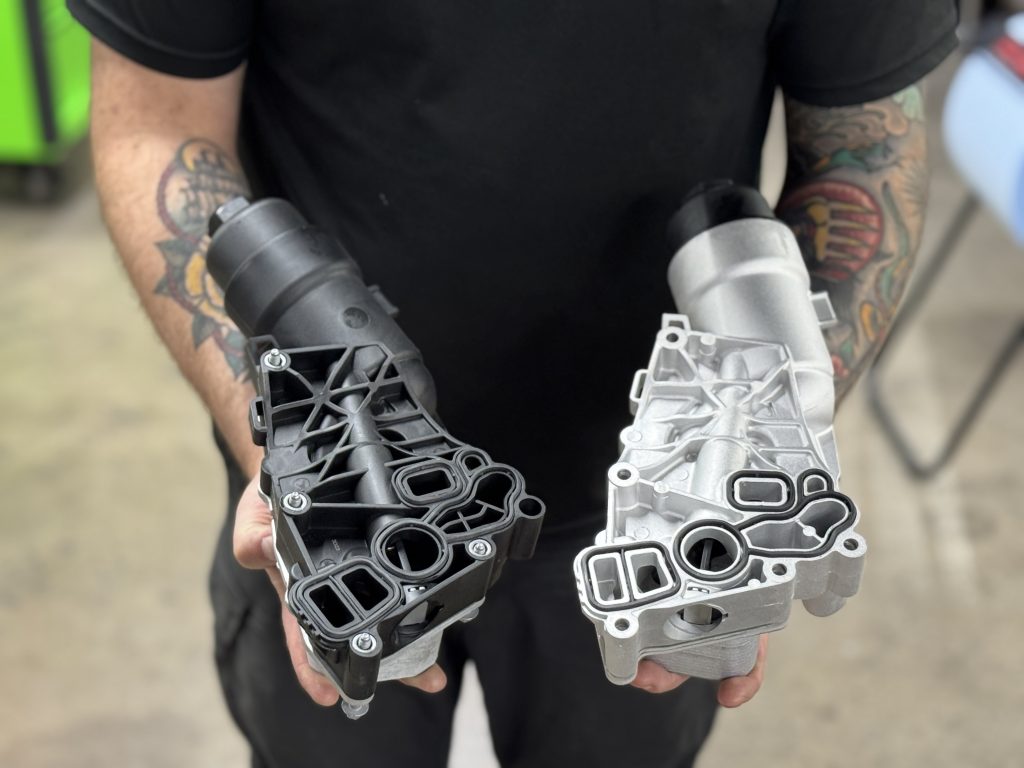
Model Specific components: Many models like Turbocharged and Hybrid variants contain additional coolant parts, or parts not immediately classified as a coolant part. An oil filter housing, for example, flows coolant through its internal channels and therefore is prone to leaks or failure of the coolant system as a whole.
Gaskets & Seals: All of the above maintain leak-free function by soft rubber gaskets, o-rings, or sealant between their connections. These are the most common failures that result in breakdown or prompt a repair.
Anti-Freeze (coolant): Older models use blue G48 coolant, 2018+ models use a newer green HT-12 coolant. Coolant must be flushed and renewed every 2-4 years to maintain its qualities and is a basic service we offer at Mporium. Overlooking this maintenance can lead to incorrect Ph levels which will result in premature failures.
Material differences and Expected Lifespan.
Modern systems such as in the BMW B46 and B58 engines are designed with ultimate goals in mind, ranging from consumer demands like vehicle costs and ever increasing performance, to engineering requirements for efficiency, manufacturing ease, weight, thermal transfer, fire safety, etc. Even governmental requirements or restrictions in manufacturing, emissions production, and end-use are considered. As a result, we see many components in modern cars being manufactured from plastic composites which we might expect to have a finite lifespan inside the harsh operating environment of a cooling system.
Many might argue that plastic is a silly choice for any coolant system part. We might agree for certain components, but the reality that comes with such system complexity is that plastic composite parts must exist, it is not feasible for all parts to be made of metal. Metal parts carry their own Pros and Cons as well, such as corrosion potential and increased expansion/contraction rates, so only certain metal parts are appropriate. Any system must be maintained and repaired appropriately. Arguing material deficiencies is not an excuse for failures that stem from lack of periodic maintenance or replacement.
We find that most failures we see in our shop had exhibited symptoms or clues long before a breakdown event. For this, we say ‘An ounce of prevention is worth a pound of cure‘!
Do you find yourself having to add coolant occasionally? The coolant systems are a sealed set of components and no significant coolant level fluctuations should occur. If your car requires occasional “topping up” of the coolant reservoirs, there is a leak that requires attention!
Leaks everywhere!
The number one enemy of these systems are leaks. It doesn’t matter if they’re small or large leaks. Any leak must be addressed promptly for several reasons.
- Leaks cause a loss of coolant resulting in a potentially unsafe level for engine health.
- Leaks result in air/steam pockets in the system which weaken other parts and seals quickly.
- Leaking coolant compromises other parts in the engine bay like wires and electronics.
- Leaking parts are compromised. They may suddenly rupture, causing a breakdown.
Leaks tend to start at one or two sites and for the above reasons will multiply quickly resulting in much higher repair costs and risk of secondary damage to other systems. An engine that has overheated may have permanent damage that may result in engine replacement being prescribed.
Service Intervals & Repair Strategy.
Servicing your BMW at a quality independent such as Mporium can provide strong protection against unexpected failures. We stress the importance of standard maintenance being performed by such shops. Seemingly basic maintenance such as an oil change puts your car in front of experts who are intimately familiar with your BMW and can spot small issues before they become a serious failure. Quick-lube facilities may seem like a convenient option at the time but because they don’t know how to identify model-specific issues before they become critical, owners may end up paying more in the long run due to missed opportunities for preventative action.
Since your BMW may only prompt a service reminder once a year, it’s a great idea to have a qualified technician provide a general health check at these visits, a task we include for free during any basic service visit. We can advise owners of any existing repair needs, but also establish a repair strategy for future service according to vehicle mileage, age, and your plans for the car.
Planning and budgeting for correct service and preventative maintenance puts you in the driver seat to perform work proactively on your budget’s own terms, rather than reactively after a catastrophic failure forces you to undergo a major, unexpected investment.
Signature Services by Mporium.
For certain models such as the newer B46 4 cylinder, and B58 6 cylinder engines in 2015+ year models, we consistently see the same type of failures that result in similar recommendations for repair actions. These often include upgraded components not available through dealers or generic euro shops. Furthermore, due to the typically significant amount of labor required to access one part, we may often include replacing an adjacent failure-prone part to take advantage of the “labor overlap” of doing both at the same time.
For these types of jobs, we offer package deals, or “Signature Services” that offer a comprehensive and long lived remedy for a very appealing ‘all-in-one’ price. Contact us to learn more.
The Mporium Difference
Mporium exclusively services BMW and MINI cars. We never dilute our knowledge over multiple brands, so our team has truly mastered every aspect of these models.
We insist on the best possible outcome for every coolant repair job. This means we have taken our years of experience and generated our own proprietary measures and combined them with a variety of products from the aftermarket, even producing some of our own products not found anywhere else. As a result we’re able to provide the most robust and longest lasting solution, without compromise. That’s our guarantee.
Contact us today for more information.